.jpg)

The ASAE Annual meeting was last week, with 5,000+ association leaders, consultants, and exhibitors gathering in downtown Indianapolis for a few days of connection and learning. We’ll admit we’re not much for conferences, but we make it a point to attend ASAE each year whether we’re presenting at the conference or not.
This year we didn’t present, so we were free to take in everything the gathering had to offer.
Here are our top three takeaways from ASAE 2026.
1 - AI was everywhere but real-world learning was thin.
We showed up at ASAE pretty excited to learn what other folks are doing with AI. We’ve been hard at work this year with our clients to learn and push on where AI has real impact, what doesn’t work, and the short and long term implications of the AI transformation we’re just beginning.
So we had high expectations in wanting to learn what else is happening across associations. While there were six sessions focused explicitly on AI, the content was mostly vendor-led. Without the on-the-ground perspective they lacked the substance we were hoping for.
It seems likely there will be a big leap in maturity over the next year that will show up at ASAE 2027. Part of that is likely timing: proposals to speak were due in December 2025, and with the speed AI is moving that was pretty early to ask associations to step forward and debrief what they’re doing, what’s working and what’s not.
We hope to hear a lot more insight next year and in other conversations in between. We’re particularly interested in how AI can be leveraged to increase member value, which is where most of our work is at the moment. And in thinking along the more strategic, transformational horizon of how AI capabilities will reshuffle how and by whom value is delivered to professionals.
If those conversations are interesting to you, we recently created the AI Working Group: a free, monthly, peer learning and sharing space for association leaders (Director level and above) who want to talk honestly and practically about AI, member value, new revenue streams, and strategy. You can apply to join here if you want to be a part of those conversations.
2 - The standout insights were about neuroscience and membership.
The best session we attended was “The Brain Based Blueprint for Stronger Membership” by Dr Heather Collins. Dr Collins is a cognitive neuroscientist.
We know from our work that creating a sentiment of career partnership and/or belonging between the association and members is highly correlated with renewal and retention, especially among early career professionals where retention rates are usually painfully low.
We’ve seen this as an effect in the work we do with our association clients: if we create analog or digital experiences and benefits that increase the sentiment of career partnership, we’ll see renewal rates increase in following years in that cohort. But we still have work to do in understanding why that happens and extrapolating those learnings into other areas.
Dr Collins gave us some new language and concepts for the why. She had two related insights we found particularly helpful.
First, the experience of career partnership, belonging and value is a reflective experience: it focuses on what happened over the last year. The decision to renew is a predictive experience: it considers what is likely to be true over the next year. This difference can sometimes, maybe often, cause a disconnect. It’s certainly why a member who got a lot of value out of one thing—say attending the annual meeting—would obviously not renew if they did not expect to attend the meeting again next year. A simple insight, but the reflective and predictive frame is super helpful.
Second, and related, when a member reflects on the career partnership or belonging they did experience in the last year and predicts if there is value in renewing their membership, the density of the implicit “value” neural network in their head is decisive.
Far too often the neural network for a member looks like this:
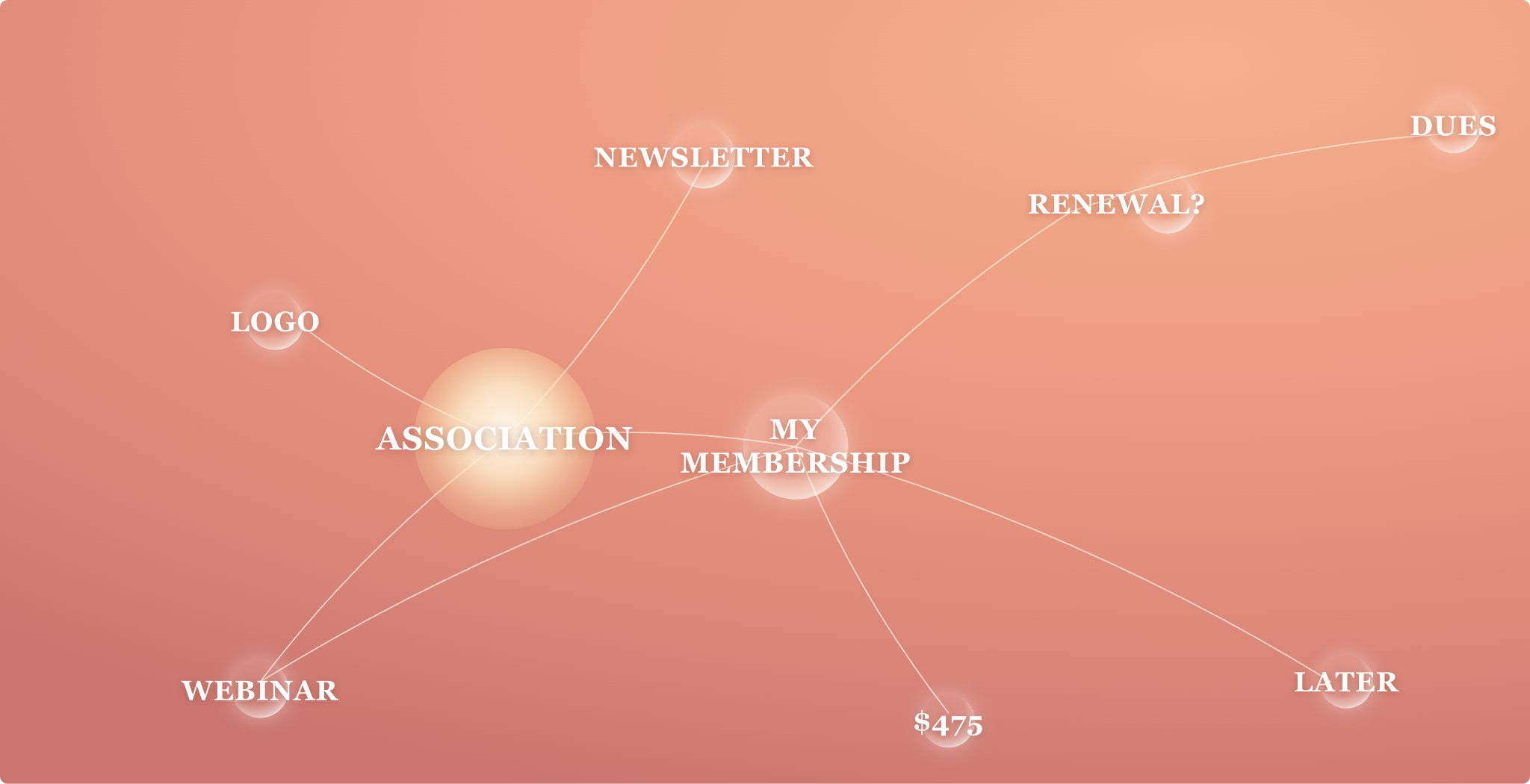
Some value, but located on a single node or a few loosely connected nodes.
A deep experience of value upon reflection could look like this:
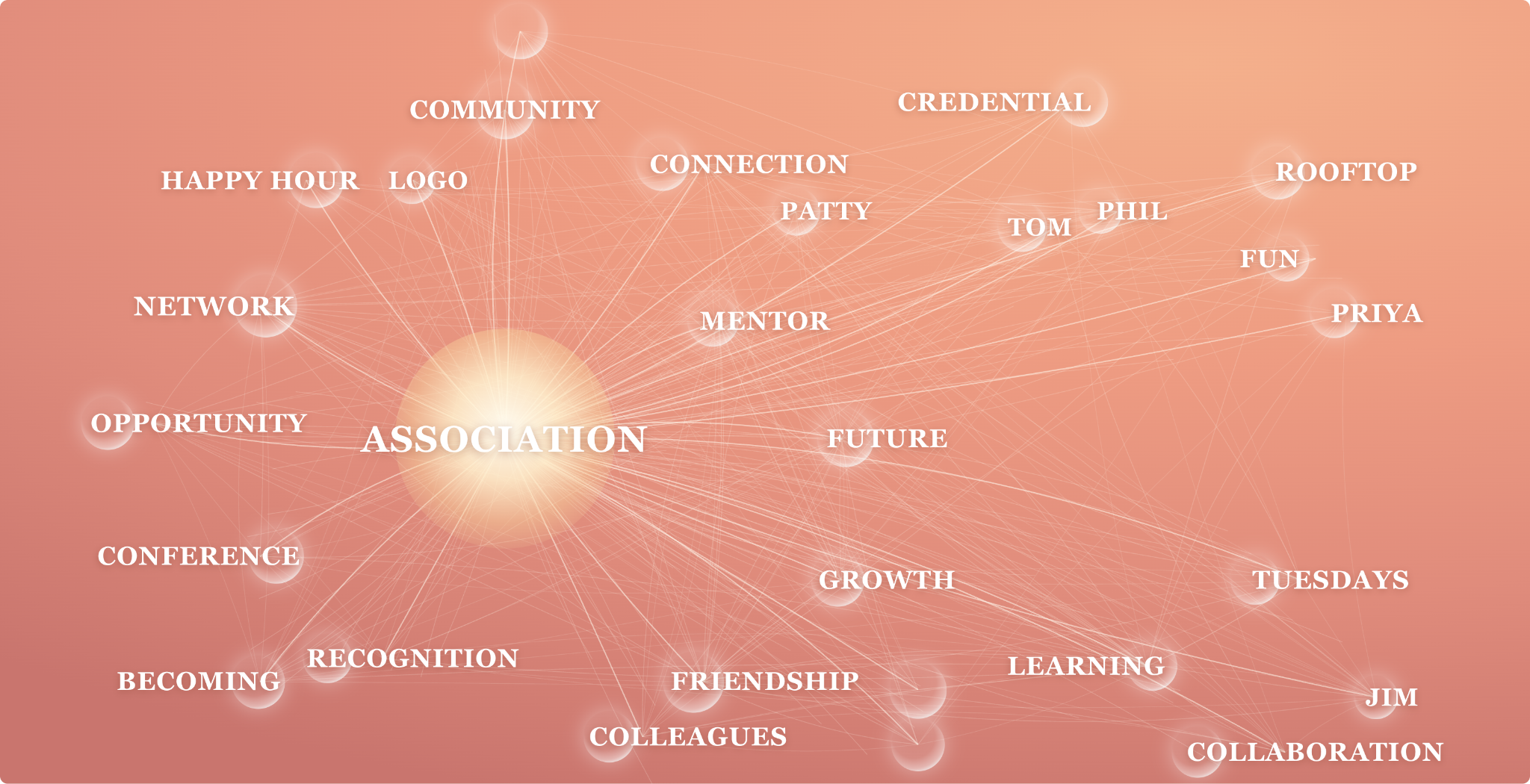
That’s a reflection that will easily translate into a prediction of future value and an easy decision to renew, even with the expectation that some circumstances might be different in the coming year than in the past. And a thing association leaders can work to influence.
3 -This is one of the kindest and most helpful communities we’ve ever met.
We know a lot of wonderful people and have made it a regular practice for more than a decade to draw great groups of people together. We gathered a small group from our own network of leaders on Sunday evening, and heard from fantastic leaders like Sid Bhatnagar, CEO at American Society of Quality, Marketa Wills, CEO at American Psychiatric Association, and Tony Smith, Senior Director of Membership at the College of American Pathologists.
But beyond our own network, we just met great, thoughtful people everywhere. From Dr Collins talking about the intersection of neuroscience and membership decisions, to Dean West generously leading the consulting community, to chatting with long-time association leader Michael Kobylka, CEO of AACE, at the PAC reception, this–as our third ASAE meeting–felt like a transition from skimming over the surface to getting to know how the community really works. The mission-driven and non-competitive nature of the space comes through, and we walked away really encouraged by the caliber of people we met.
And that’s the right note to end on, because in whatever work we do, the good work is when people come first.
