


When I talk with association CEOs and Executive Directors, there is a deep concern behind all the talk of strategies, offerings, metrics and mission: something about membership is broken, and we don’t know how to fix it.
This isn’t an anecdote. We’ve consulted with over half of the 50 largest associations in the US and interacted with many more through our annual Young Professional Membership Index and Future of Membership Cohorts. This is the norm.
There’s a problem at the core: paid membership is declining
Paid professional membership is declining in real numbers at most associations. And to the best of my knowledge, if you look at market share—dues paying members as a percent of the total number of practicing professionals—membership is declining everywhere.
For some associations this problem is obvious: the total number of members are down. Everyone can see that something significant has changed, even if we don’t understand why or what to do about it.
For others associations the problem is obscured by two other trends:
First, the total number of dues paying members each year may hold steady because of improvements in new member recruitment. A large number of new members join every year to get access to something valuable: conference discounts, certification, continuing education, etc. The increase in recruitment each year compensates for the fact that very few of those first time members become the sort of loyal, ongoing members that our models have long depended on. Marketing and membership teams are doing 3-5 times the work to attract new “members” through one-off purchases and discounts just to hold the top line of membership steady, disguising the incredible churn under the surface.
Second, new membership classes have expanded membership into student memberships and retired memberships. These expansions drive the total number of members up, sometimes dramatically, disguising the fact that the number of core historical professional members is in decline. This often leads to the odd scenario where total membership numbers are going up while membership dues revenue is going down.
The root of the problem is early career retention
The math is simple: older, longtime members are retiring in increasing numbers, and there are not enough new younger members to take their place.
There are enough younger professionals in the market. They just don’t stay members.
If you look at medical societies, typically only 30-40% of residency or fellowship “members” choose to become dues paying members when they enter practice. Even fewer become long-term perennial members. In many medical societies for every 100 early career professionals graduating from training, only 15 or 20 of them are still members three years later.
The metrics are even worse in professional and scientific societies, where three year retention of early career professionals can be as low as 10 to 15%.
If these trends continue, the financial sustainability and missional impact of professional associations will be greatly diminished in less than a generation..
Why is early career retention so low?
Why don’t membership offerings stick for early career professionals?
The reasons are fairly easy to understand, even if they’re not easy to solve.
First, the digital revolution unbundled the association value prop and made each individual component easy and often free to receive elsewhere. Advice, professional connections, ongoing content, continuing education and more were all unbundled by various digital providers. Suddenly various parts of the membership value prop were in competition with LinkedIn, Reddit, Google and YouTube. Now we can add Claude and ChatGPT to that list.
It’s an intimidating set of competitors to say the least, and using these platforms as a DIY alternative to significant parts of the association’s offerings is now the norm for early career professionals.
While digital unbundling is the most impactful trend, there are other forces working against membership as we have known it over the past 100 years:
- The diminishment of broad social ties in our culture and the rise of political polarization;
- More protective norms around work/life balance reducing the amount of time people are willing to spend “working” outside of traditional work hours;
- The expectation of highly relevant offerings instead of the broad serendipitous connections and services where associations have historically excelled.
For early career professionals, joining and staying are now two separate decisions
Because early career professionals are accustomed to navigating digital platforms for content, connections and opportunities that historically were part of the association offering, they tend to only join the association for highly specific offerings like preparing for a board exam, attending a major event, or achieving a certification.
In short, early career professionals tend to join associations as customers, not as members. Said a different way, they join as contingent members for a very specific reason. It’s not a decision to become a perennial or long-term member, and once the specific reason is completed, they stop being a “member”.
For early career professionals the decision to join and the decision to stay are two separate decisions.
Associations are perhaps better than they’ve ever been at providing early professionals a reason to join by the way they promote and position membership for event discounts, certifications, and more. But associations are simultaneously less successful than they have ever been at providing a compelling reason for those new members to stay.
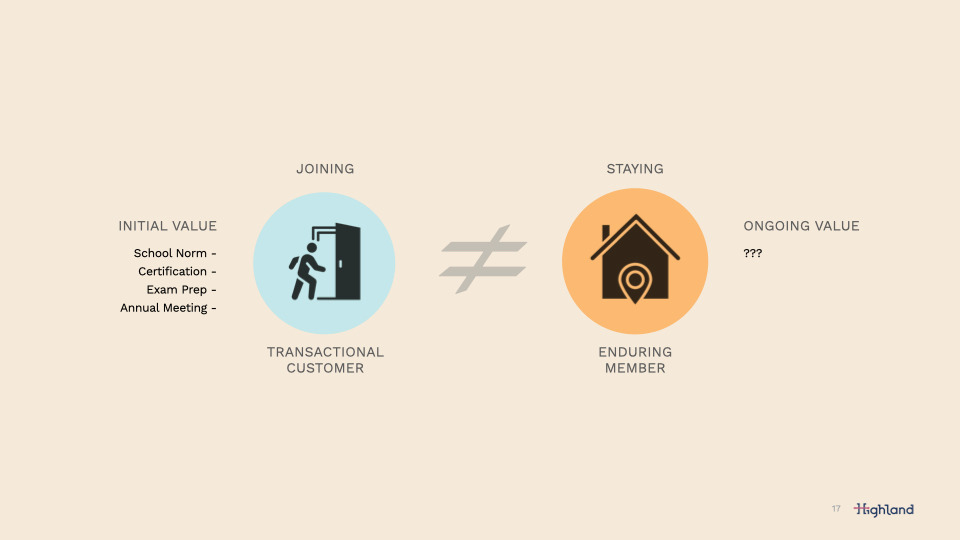
Not that long ago the reasons to join and the reasons to stay were essentially the same for professionals as they entered their career. This is the world that current board members and retiring members lived in for decades: where you joined an association for a complex of reasons–professional networking, ongoing education, credibility, contributing to the advancement of the profession–that were also the same reasons to stay.
In this environment associations only had to win one decision: the decision to join. But now we operate in an environment where associations have to win two distinct decisions: the decision to join and the decision to stay.
We must design to win both joining and staying
How do we solve this disconnect at the heart of the existential crisis of membership?
We must design our membership offerings and experiences to win both the joining and the staying decision.
Let’s continue to press into the strength of the joining moment and the transactional reasons that draw early career professionals as contingent members. But then we must see the year that follows that contingent joining decision as an opportunity to shift them from the mindset of a transactional customer to the mindset of an enduring perennial member.
Dr Heather Collins is a neuroscientist who presents on the science of trust, including the mental models that lead to membership renewal or lapse.
When we win the joining decision and then do not capitalize on the opportunity to win the staying decision, the mental model of the early career professional member at the end of that first year may look something like this:
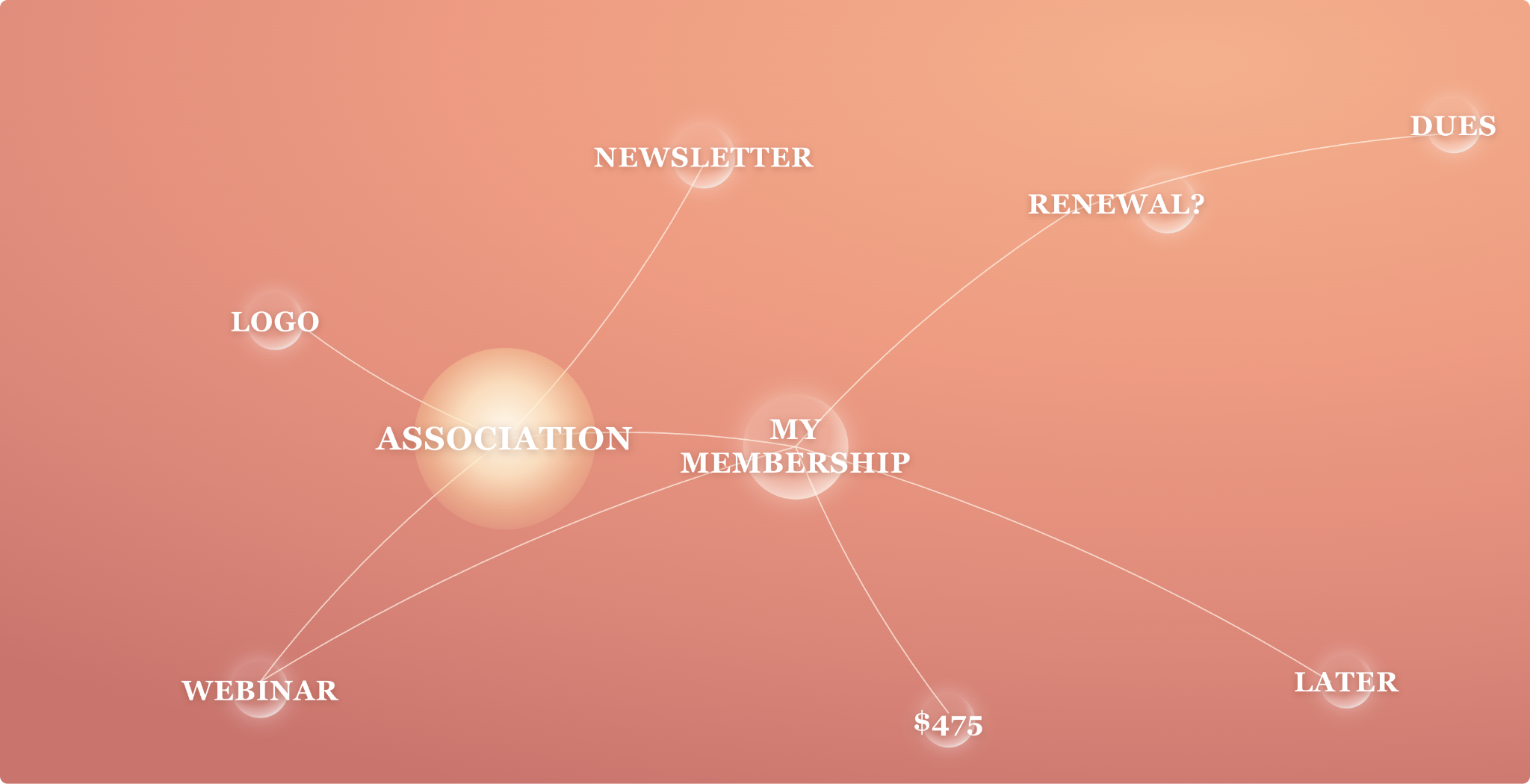
This member may be satisfied with their membership for this past year. Satisfaction is a reflective exercise, and they likely got a very specific need met. But renewal is a predictive exercise, and this mental model will lose the staying decision. With the transactional need complete, there is no logical forecast that makes staying a reasonable choice.
But when we win the joining decision and then intentionally design the member experience from that moment of opportunity, we can create a mental model at the end of the first year that looks like this:
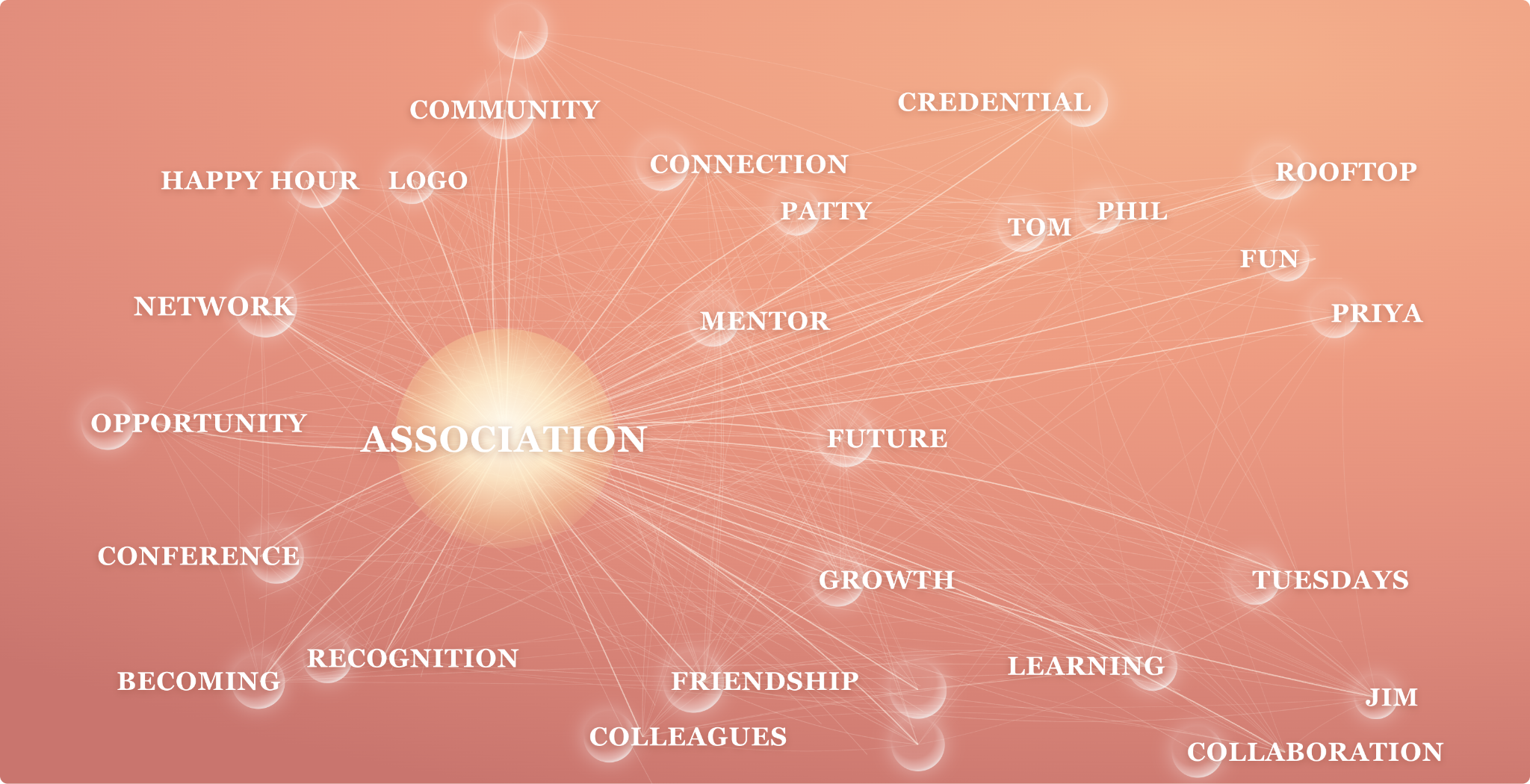
This mental model wins the staying decision. The last year of membership was valuable for interlocking reasons and there is a reasonable forecast that makes staying a good choice.
Career partnership wins the staying decision
What is the value proposition that could possibly make membership stick for early career professionals?
All of our research and work over the last five years says that it is career partnership. Young professionals want assistance in navigating the advancement of their career.
Continuing education will not win the staying decision. Online forums, mentoring programs, annual meetings, or regional events will not win the staying decision.
But a belief that the association intends to partner with them to help them advance their career moves the needle on early career retention.
As we’ve worked with associations to build and test early career partnership experiences, we’ve found evidence that increasing the sentiment “this association is an essential partner in my career” by 8-10% can result in a nearly 50% increase in renewals for a second year of membership.
Winning the staying decision with career partnership is far easier said than done, however. Most associations have shifted, without really meaning to, from a career partner–one trusted relationship that holds the essential infrastructure of advancing their careers–to a purveyor of career products and services. We need to renew and reimagine career partnership for a new era and a new generation.
What career partnership requires
Becoming an essential career partner to early career professionals today requires an update in both mindset and capabilities for association staff and leaders.
Great partners do several things well:
- Anticipate needs
- Respond to emotion
- Offer guidance at the right moment
- Create confidence and clarity
- Make the journey possible
Becoming a career partner requires shifting from the current patterns of a provider of career products and services–discrete offerings, promotions, discount offers, sprawling website menus, and a deluge of emails–to the behaviors of an essential career partner: specific member journeys, designed experiences, and AI-driven career coordination hubs.
The crisis doesn’t always feel urgent, but it is
This crisis isn’t new. It’s been apparent for the better part of a decade, but associations haven’t responded with urgency despite its existential nature.
I think in part this is because membership is a compounding function: the impact in one year is small, but the trajectory over time is exponential.
Let’s imagine an association with 100,000 members and $90M in annual revenue. Each year 5,000 new practitioners enter the field. Today only 1,000 of those professionals are still members after the first few years. This is obviously unsustainable and will eventually greatly diminish the association.
But if we could instantly triple that number to 3,000, factoring in discounts that have been designed to entice early career members to stay, the first year change in revenue would only be ~$300,000. For a $90M organization, that doesn’t feel important.
But if we sustain that level of 3,000 new early career members each year instead of 1,000 for the next 10 years, the impact is obvious: 20,000 additional members and ~$30M in member dues revenue alone.
It nearly goes without saying, the time to act is now.
Non-dues revenue is not a viable replacement
The search for relevance and revenue in the face of declining early career membership has led many leaders down the path of non-dues revenue: sponsorships, employer offerings, and other mechanisms to serve the industry and create alternative revenue streams. A few associations have been quite successful down these paths, and the stability non-dues revenue can offer is obviously good.
However, over the last decade, associations have often done this at the expense of addressing the crisis in the core of membership. Instead of strengthening the core and using non-dues revenue as additional impact and scale, many associations have sought to use non-dues revenue to compensate for the growing weakness in the core.
We must do both, and we must urgently work to alter the dramatic decline among early career members.
AI will intensify this challenge and present a once-in-a-lifetime opportunity
It’s impossible to talk about membership trends without considering how AI will impact our strategies.
AI agents like Claude and ChatGPT will greatly intensify the challenges caused by the digital revolution. Content will be incredibly hard to keep gated and out of these models, and personalization of content and advice will happen at a scale we have never seen before.
However, AI will also greatly increase the value of trust. The strategic question for associations will shift from “what content do we own?” to “what trusted position do we occupy?”
The opportunity to deliver career partnership as a trusted partner, coordinating between people, employers, schools, certifying bodies and more is tremendous, and may very well be the strategic opportunity for associations in our lifetimes.
Highland exists to modernize the core value of membership
We partner with association CEOs to address the existential crisis in membership. We help address the core challenge through three pillars:
- Understand the behavior, needs and motivations of members with actionable insight through our Member Pulse research & strategy offering.
- Design ongoing experiences that shift associations from purveyors of career products and services into true career partners, growing membership among early career professionals.
- Create AI-driven digital career coordination hubs that deliver career partner value at scale, using technology designed to meet early career professionals digitally and connect them into the enduring value of community and people within an association.
